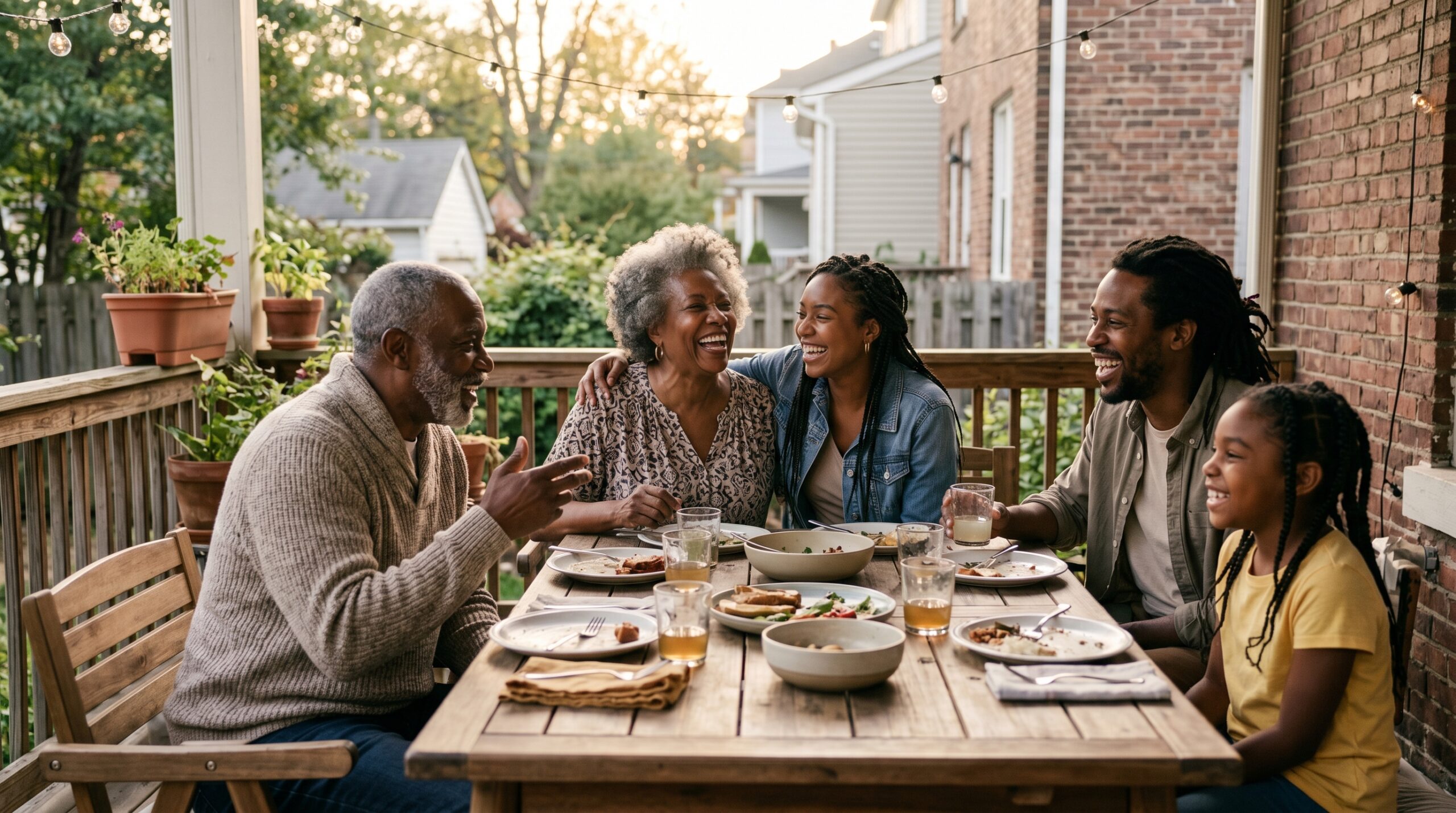
If you only ever hear about a community in the language of its suffering, something true gets left out.
Earlier this week we wrote about racial trauma, the real toll that racism takes on the mind and body. This is the other half of that conversation. Healing from racial trauma is not only about processing pain. It is also about protecting the joy, connection, and culture that have kept people whole through generations of it. That is not a feel-good add-on. There is good research behind it, and it changes how care should actually work.
In this article
- Two things can be true at once
- What the research says about joy and identity
- Why people call it resistance
- Community as medicine
- What this means for therapy
- Where to start
- Frequently asked questions
Two things can be true at once
One of the quiet harms of focusing only on trauma is that it can flatten a person into their wounds. People are more than what has happened to them. A person can be carrying real grief from race-based stress and also be funny, creative, deeply loved, and fully alive in the same week. Therapy that only ever reaches for the pain misses most of the person sitting in the room.
Joy and grief are not opposites that cancel out. They coexist. Making room for both is not a way of skipping the hard work. It is part of how the hard work becomes survivable.
What the research says about joy and identity
This is where the science is more encouraging than people expect. A large 2014 meta-analysis in Child Development found that positive feelings about one’s race and ethnicity were linked to higher self-esteem, better social functioning, and fewer depressive symptoms in young people of color. A companion review the same year reached a similar conclusion: a strong, positive ethnic-racial identity tends to function as a protective factor for psychological health, with the evidence especially clear for Black adolescents.
Read that the way a clinician does: pride and belonging are not soft extras. They behave like protective equipment for the mind. Strengthening a person’s connection to who they are and where they come from is doing real preventive mental health work.
Why people call it resistance
There is a long tradition, from Audre Lorde to Toni Cade Bambara, of describing joy and self-care among Black communities as a form of resistance. Lorde’s line is the one that gets quoted most: caring for yourself is “self-preservation, and that is an act of political warfare.” The idea is simple and sharp. In a world that profits from your exhaustion and expects your pain, choosing rest, celebration, and connection is not frivolous. It is a refusal to be reduced.
I want to be clear about what is research and what is tradition here. The protective effect of identity and belonging is measured in the studies above. “Joy as resistance” is a cultural and clinical framing, a way of understanding why protecting joy matters so much under pressure. I find it true and useful in the room. I am naming it as a frame, not as a lab result.
Community as medicine
Ask people of color where they have actually felt held, and the answers are rarely a clinic. They are a kitchen, a barbershop, a church, a cousin’s porch, a group chat, a cultural celebration. Those spaces do something therapy cannot do alone: they offer belonging without requiring proof of the wound. The researchers who study racial trauma make this point directly, noting that healing draws on collective, cultural, and community resources, not only individual treatment.
This matters even more in a place like Southern Oregon, where those communities can be smaller and harder to find. Part of good care here is helping people locate and protect their sources of belonging, not just process what hurts.
What this means for therapy
A trauma-informed therapist who takes this seriously will ask about more than your symptoms. We will ask what feeds you, what makes you laugh, where you feel most yourself, who your people are. Not as small talk, but because those are clinical resources, the things we want to protect and grow while we work on what is heavy. This sits alongside the nervous-system work we describe in our piece on small practices for regulation: settle the body, and protect the joy, at the same time.
None of this is toxic positivity. We are not going to tell you to look on the bright side, and we are never going to ask you to perform being okay. Real care holds the grief and guards the joy, both, without making you choose.
Where to start
If the heaviness has crowded out the parts of life that used to feel like yours, that is worth bringing to therapy, and so is the goal of getting them back. You do not have to be in crisis to want more room for joy.
At Helping Hand Therapy we offer culturally affirming, trauma-informed care in Central Point and Ashland, and by telehealth across Oregon. You can reach out for a free consultation whenever you are ready.
If you are in crisis right now, you can reach the 988 Suicide and Crisis Lifeline any time by calling or texting 988.
Frequently asked questions
Isn’t focusing on joy just avoiding the real problem?
No. Protecting joy and connection is not the same as avoiding pain. Research links a positive sense of identity and belonging to better mental health, so building those up is part of healing, not a way around it. Good therapy does both at once.
Is “Black joy as resistance” a clinical concept?
It is a cultural framing with deep roots, from writers like Audre Lorde, that many clinicians find useful. The measurable part is that a strong, positive ethnic-racial identity tends to protect psychological health. The “resistance” language is a way of understanding why that protection matters under ongoing pressure.
Can therapy really help with something as collective as racism?
Therapy cannot end racism, and it should not pretend to. What it can do is help your nervous system recover, help you carry what is heavy, and help you protect the relationships and joy that keep you whole. Healing from racial trauma leans on community alongside individual work.
Does Helping Hand Therapy offer culturally affirming care near me?
Yes. We provide trauma-informed, culturally affirming therapy in Central Point and Ashland, Oregon, and by telehealth statewide. You can reach out through our appointment request page.
Michael Higginbotham, LPC, is co-owner of Helping Hand Therapy in Southern Oregon. He works with trauma using EMDR (EMDR Basic Trained, working toward EMDRIA Certification), somatic approaches, and mindfulness, and writes on mental health, equity, and belonging in the Rogue Valley. Helping Hand Therapy provides care in Central Point and Ashland, and by telehealth across Oregon.