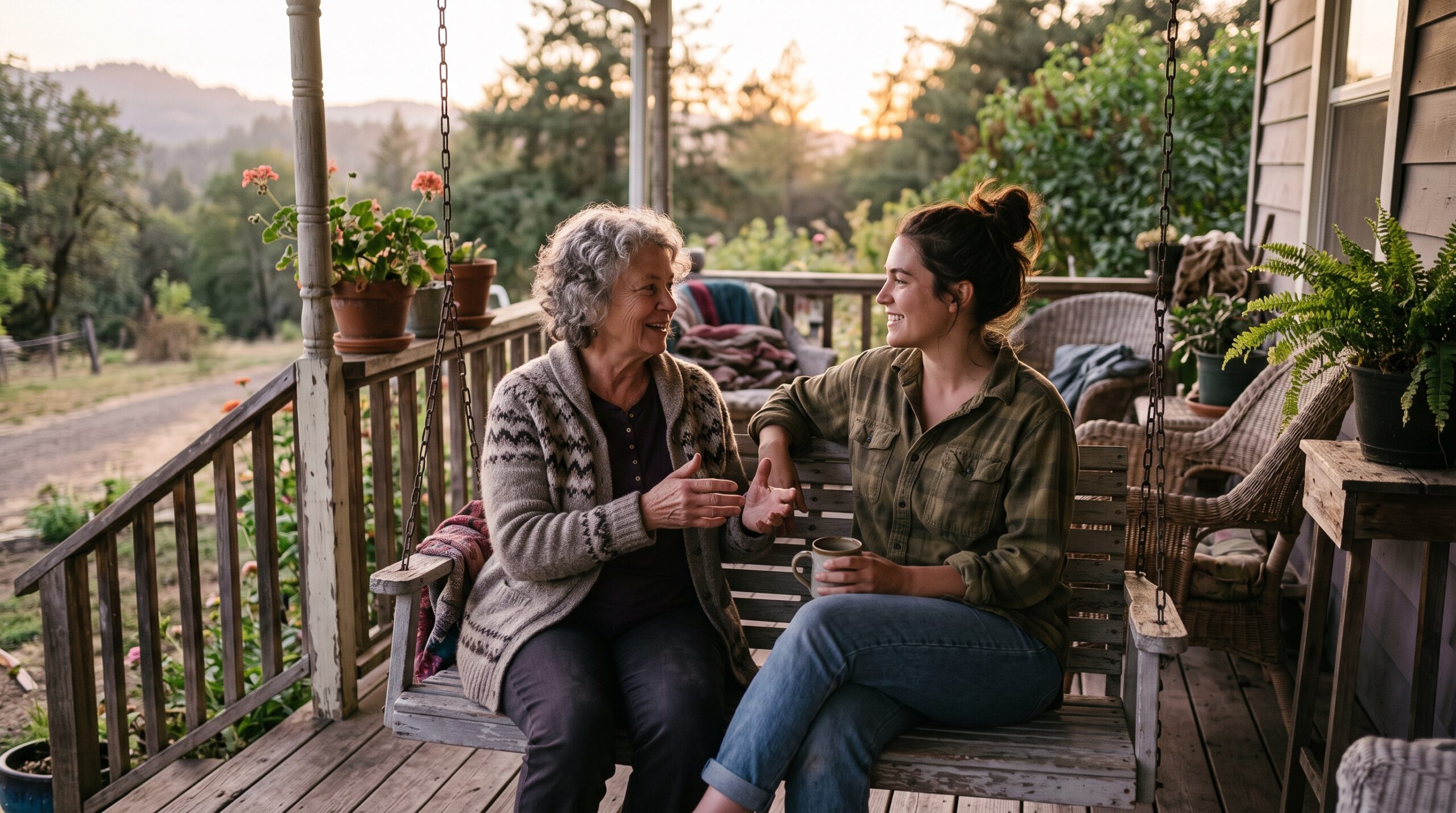
We just spent a holiday celebrating independence. It is worth saying the quieter truth alongside it: no one actually makes it through a life alone.
The story that you should be able to handle everything by yourself is one of the most common, and most costly, things people carry into a therapy room. It sounds like strength. In practice it often means suffering longer than you had to. Reaching out is not weakness or failure. It is how humans are built to get through hard things, and there is a large body of research to back that up.
In this article
- The go-it-alone story
- What connection does for your health
- Why asking for help feels like weakness
- Independence and interdependence are not opposites
- What reaching out can actually look like
- Connection in the Rogue Valley
- Where to start
- Frequently asked questions
The go-it-alone story
Self-reliance is woven deep into American culture, and it has real value. The trouble starts when it hardens into a rule: that needing anyone is a flaw, that the strong handle it alone, that asking is admitting defeat. A lot of people, and in our experience a lot of men in particular, absorb that rule early and pay for it quietly for decades. We wrote about that pattern in our piece on why men don’t go to therapy.
The reframe we come back to often: independence and isolation are not the same thing. You can be a capable, self-sufficient adult and still need people. Those two facts have never been in conflict.
What connection does for your health
This is not a soft, feel-good claim. It is one of the better-established findings in health research. A landmark review that pooled data from more than 300,000 people found that people with stronger social relationships had roughly a 50% higher likelihood of survival, an effect the researchers compared to well-known risk factors like smoking.
The flip side holds too. A later meta-analysis found that loneliness, social isolation, and living alone each raised the risk of early death by roughly a quarter to a third. Connection is not a luxury layered on top of health. It is part of the foundation.
Why asking for help feels like weakness
If reaching out is so good for us, why does it feel so bad to do? Part of the answer is cultural conditioning. Part of it is older than that. Research on the brain found that social rejection lights up some of the same neural territory as physical pain. Being left out really does hurt, and the fear of being judged for needing help is a real, felt thing, not a character flaw.
So the resistance makes sense. It is worth naming that so you can move through it instead of obeying it. Feeling exposed when you ask for help is not a sign you are doing something wrong. It is a sign you are doing something that matters.
Independence and interdependence are not opposites
Healthy adulthood is not the absence of needing people. It is knowing how to lean on the right people at the right times, and being someone others can lean on too. That back-and-forth has a name: interdependence. It shows up in every relationship that actually works, which is part of what we get into in what healthy love actually looks like and in how early attachment patterns shape our comfort with closeness as adults.
The nervous system knows this even when the culture argues with it. We settle faster in the presence of a calm, safe other person. Clinicians call it co-regulation, and while the mechanisms are still being studied, the felt experience is universal: hard things are more survivable when you are not carrying them completely alone.
What reaching out can actually look like
Asking for help does not have to be a dramatic confession. Often it is small and ordinary: telling one friend the real answer when they ask how you are, saying yes when someone offers, naming a need out loud instead of hoping to be read. It can be a text, a phone call, a walk with someone who gets it. And sometimes it is booking the appointment you have been putting off.
None of those are last resorts. They are the ordinary maintenance of a human life. If the idea of starting still feels heavy, our guide to finding a therapist who actually gets you is a gentle place to begin.
Connection in the Rogue Valley
Southern Oregon has a strong self-reliant streak, and a lot to love in it. It can also make reaching out harder, especially in smaller or more rural pockets where everyone seems to be managing fine on their own. If you have been white-knuckling something alone here, you are almost certainly not the only one on your street doing the same. Community is one of the real resources this valley has, from neighbors to faith communities to local support groups. It counts, and it helps.
Where to start
If you have been holding something heavy by yourself because asking felt like giving up, consider this your permission to stop. You do not have to have it all figured out to reach out. That is often the whole point of reaching out.
At Helping Hand Therapy we offer care in Central Point and Ashland, and by telehealth across Oregon. You can reach out for a free consultation whenever you are ready.
If you are in crisis right now, you can reach the 988 Suicide and Crisis Lifeline any time by calling or texting 988.
Frequently asked questions
Isn’t relying on others a sign I’m not coping well?
No. Leaning on others at the right times is a feature of healthy adulthood, not a failure of it. The research is clear that strong social connection supports health, while isolation carries real risk. Needing people is human, not weak.
Why does asking for help make me so anxious?
Partly conditioning, partly biology. Many people are raised to equate needing help with weakness, and the brain treats the risk of social rejection a lot like physical pain. That discomfort is common and does not mean you are doing anything wrong.
What if I don’t have anyone to reach out to?
That is worth taking seriously, and it is something therapy can help with directly, both by supporting you now and by helping you build connection over time. Reaching out to a professional is a valid first thread to pull.
Does Helping Hand Therapy offer support near me?
Yes. We see clients in Central Point and Ashland, Oregon, and by telehealth statewide. You can reach out through our appointment request page.
Michael Higginbotham, LPC, is co-owner of Helping Hand Therapy in Southern Oregon. He works from an existential, relational, and trauma-informed approach, using EMDR (EMDR Basic Trained, working toward EMDRIA Certification), somatic work, and mindfulness. Helping Hand Therapy provides care in Central Point and Ashland, and by telehealth across Oregon.