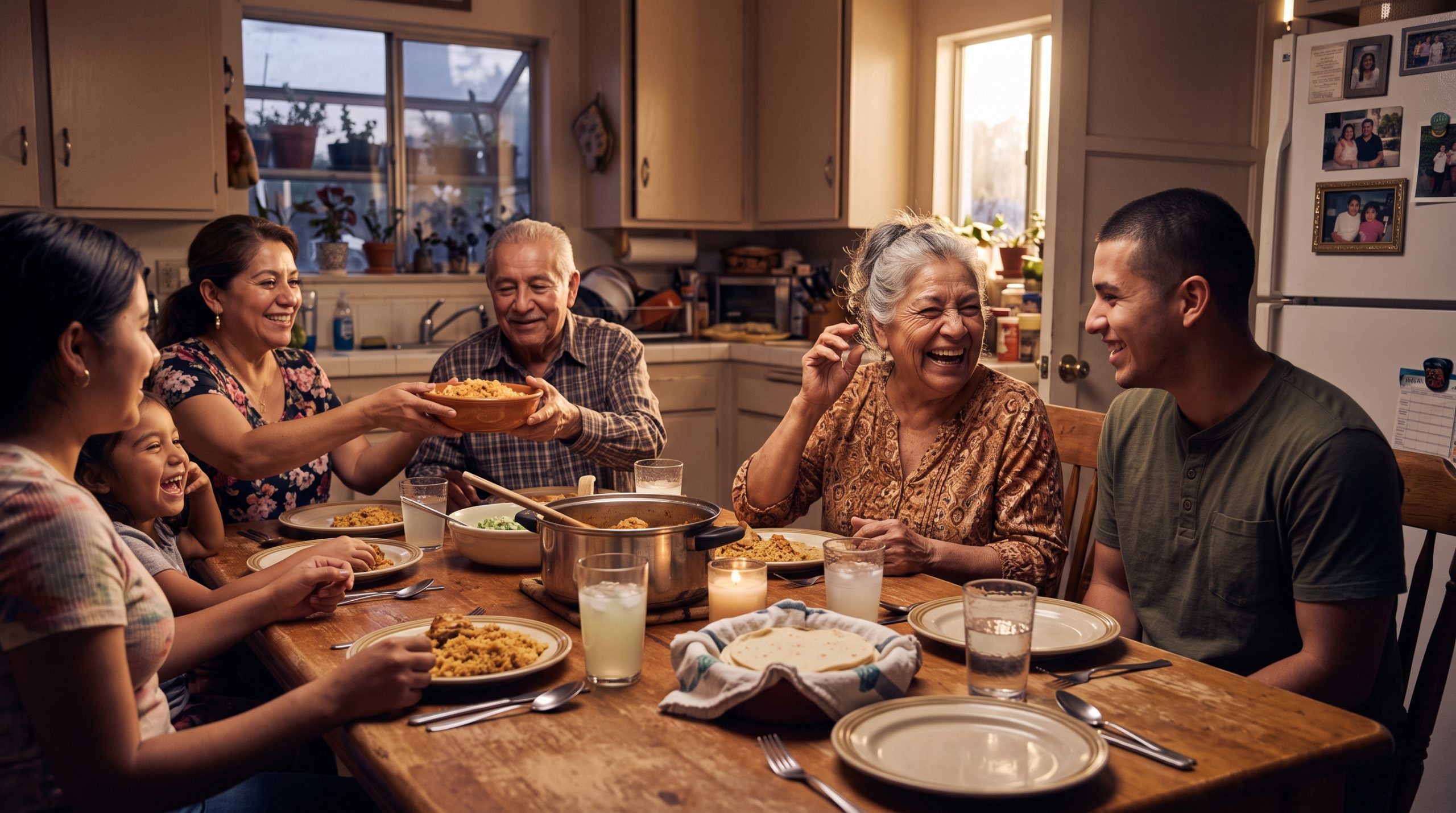
Hispanic Heritage Month starts this week. Here is the part of the story the statistics usually crowd out: the strength.
September 15 to October 15 is Hispanic Heritage Month, and about one in six of our Jackson County neighbors is Hispanic or Latino, according to the U.S. Census. This piece holds two true things at once. Hispanic and Latino adults who need mental health care get it less often than they should, and the reasons are mostly practical, not personal. And the same communities carry real, researched sources of strength, family, culture, faith, and community, that belong at the center of healing rather than at its margins.
In this article
- The gap is real, and it is not about willingness
- What actually stands in the way
- Family as a source of strength, with both hands
- What good fit looks like, and what we can offer plainly
- Rooted here: Latino Southern Oregon
- Local and Spanish-language resources
- Where to start
- Frequently asked questions
The gap is real, and it is not about willingness
Start with the honest number, held gently: in the most recent national survey, fewer than half of Hispanic and Latino adults living with a mental health condition received treatment, compared with more than half of non-Hispanic adults, per federal survey data. It would be easy to read that gap as reluctance, and for years many people did. The research reads it differently. When care is affordable, nearby, and culturally responsive, the willingness shows up. The gap lives mostly in the system, not in the person, which is the same pattern we wrote about during BIPOC Mental Health Month. That matters, because a system problem can be worked on, and a person wrongly blamed for it can set the shame down.
What actually stands in the way
The barriers are concrete. Cost and insurance coverage sit at the top, and Hispanic adults are uninsured at far higher rates than white adults. Language access is thinner than it should be, with only a small fraction of therapists able to offer care in Spanish and Spanish-language services shrinking in recent years rather than growing. Add distance, work schedules that do not bend, and for some families, worry about how any system might treat them, and the picture explains itself. None of these barriers is a character trait. Every one of them is a design problem, and naming them plainly is the first honest step.
Family as a source of strength, with both hands
Researchers who study Latino family life keep landing on a word that has no tidy English equivalent: familismo, the deep prioritizing of family bonds, loyalty, and mutual care. The research links close family connection with better mental health on several measures, and clinicians see the living version of it all the time: the cousin who drives you to the appointment, the grandmother whose kitchen is the original group therapy, the family that shows up in force when one member struggles.
And we will hold it plainly rather than romantically. The same closeness that protects can also press, when one person carries the family’s needs ahead of their own for too long, or when being the strong one leaves no room to struggle. Both truths fit in the same family. Therapy that respects familismo does not ask anyone to choose between their family and their wellbeing. It treats the family bond as an asset in the work, and makes room for the person inside the bond too.
What good fit looks like, and what we can offer plainly
Many people prefer a therapist who shares their background, and that preference deserves respect. The research adds something freeing here, the same finding we shared in July: what predicts progress most is how the therapist works, curiosity, respect, taking your world and your family seriously, more than shared background alone. Culturally adapted care measurably outperforms one-size-fits-all care, and adapting is the provider’s job, not the client’s.
So here is our plain version, because clarity beats implication: Helping Hand Therapy provides care in English, and we do not currently have Spanish-speaking clinicians. What we offer is whole-person, culturally humble care that welcomes your family’s role in your life, honors faith and tradition as strengths, and never asks you to translate yourself into someone else’s mold. And where Spanish-language care is the right fit, the resources below are strong, local, and real.
Rooted here: Latino Southern Oregon
Latino families are not new to this valley. More than 15,000 braceros worked Oregon farms in the 1940s, and generations of families have built lives, businesses, and community here since, much of it woven through the orchards and agriculture that made the Rogue Valley what it is. Hispanic Heritage Month is a national observance, and it is also simply a local fact: this heritage is part of what Southern Oregon is. Mental health care here should reflect that.
Local and Spanish-language resources
These are established, verified organizations serving Latino Southern Oregon:
- La Clinica, Medford area: nonprofit community health centers serving everyone regardless of insurance or ability to pay, sliding-scale fees, integrated behavioral health, decades of service to Latino and farmworker families.
- Unete, Center for Farm Worker Advocacy, Medford: health navigation, insurance application help, and farmworker and immigrant family support since 1996.
- Oregon Human Development Corporation, Medford office: statewide farmworker services including housing and utility assistance.
- 988 in Spanish: call 988 and press 2, text AYUDA to 988, or chat at 988lifeline.org/es, free, confidential, 24/7.
Where to start
If this month has you thinking about your own load, or about someone in your family who carries too much of everyone else’s, we would be glad to talk. Helping Hand Therapy sees clients in Central Point and Ashland, and by telehealth across Oregon. The first step is a free 30-minute consultation: request an appointment here.
Frequently asked questions
Is it true that Hispanic and Latino people are less open to therapy?
The research says the openness is there. The treatment gap traces mostly to practical barriers, cost, coverage, language access, distance, and finding care that fits. When those barriers come down, help-seeking rises.
Does Helping Hand Therapy offer services in Spanish?
Not at this time. We provide care in English and we say that plainly rather than implying otherwise. For Spanish-language support, La Clinica in the Medford area offers integrated behavioral health on a sliding scale, and 988 offers Spanish-language crisis support anytime: press 2, or text AYUDA to 988.
Can therapy respect my family’s role in my life?
Yes, and it should. Good care treats close family bonds as a strength in the work, while making room for your own needs inside those bonds. You should never have to choose between your family and your wellbeing.
What does culturally responsive care mean at HHT?
It means curiosity about your world instead of assumptions, respect for faith, tradition, and family as part of who you are, welcoming correction when we get something wrong, and adapting how we work so care fits you. That is the provider’s job, and research shows it is what actually moves outcomes.
About the author
Michael Higginbotham, LPC, is a Licensed Professional Counselor and co-owner of Helping Hand Therapy, with offices in Central Point and Ashland, Oregon. He works from an existential and trauma-informed perspective and is EMDR Basic Trained, working toward EMDRIA Certification. Helping Hand Therapy offers person-first, affirming care in person and by telehealth across Oregon.
Helping Hand Therapy, Central Point (billing and clinical) and Ashland (clinical), Oregon. Serving the Rogue Valley and all of Oregon by telehealth.